Interlagos
 Flag of Brazil


Circuit Overview
Interlagos is something of a throwback circuit, built in the 1940s and updated just enough over the years to satisfy the demands of Formula One without destroying its essential character.
Drivers and spectators love it, though with its historically primitive paddock facilities, teams have been more lukewarm. Quite how Interlagos retained its F1 spot is something of a mystery when you consider the pillorying Silverstone took from Bernie Ecclestone to update its facilities, but with various alternatives failing to happen, it clings on for now, happily with much improved facilities.
Today the track boasts a full calendar of events at national level, as well as F1. Stock Car Brasil and Copa Truck are seasonal highlights on four wheels, with SuperBike Brasil providing the best of the two-wheel action.

Circuit History
The circuit's history began in 1926, when a real estate company led by British entrepreneur Louis Romero Sanson began designing a new suburban area as part of the expansion of São Paulo. Known as 'Balneário Satélite da Capital', the project envisaged the creation of housing, large roads, and a multi-sport complex located in between the two enormous reservoirs which supply the city with drinking water.
After hiring Alfred Agache, a French urban planner who had been responsible for a redevelopment scheme in Rio de Janeiro, the proposals acquired their new name; Agache thought that the site reminded him of Interlaken in Switzerland, and thus Interlagos (meaning 'between lakes' in Portuguese) was adopted.

The stock market crash of 1929, combined with years of political turmoil within Brazil, ultimately put paid to most of these plans, including those of the motor racing circuit within the sports complex. Nevertheless, Brazilian racing continued, with street races arranged in both Rio and São Paulo. It was at the latter of these events that disaster struck: French pilot Hellé-Nice lost control of her Alfa Romeo at the end of the race and hit nearby spectators. The accident resulted in 4 people dead and another 37 injured.
A permanent circuit is needed
Racing clearly needed a safer environment to continue in and the president of the Automobile Club of Brazil, Eusébio de Queiroz Mattozo, urged Sanson to complete the Interlagos circuit. Sanson began researching circuit design, taking inspiration from Roosevelt Raceway in the U.S.A.; Brooklands in Great Britain; and Montlhéry in France.
Construction began in 1938 and the track was paved the following year. A lack of funds meant that facilities were very basic at the planned original opening; the grandstands and pit facilities would have to wait for many years before being complete, but the track itself was ready for racing. Unfortunately, the weather gods were not so welcoming and the original inauguration in November 1939 had to be postponed to the following year.

So it was that a grid of cars lined up on 12 May 1940 for the the 3rd Grand Prix of the City of São Paulo. Motorcycle races helped make up the undercard. The drivers and riders found a fast but technical circuit which wound its way back and forth between the lakes and across the contours of the land. Despite the basic facilities, around 15,000 people came out to watch those races in Brazil's first circuit. The Grand Prix was won by Brazilian driver Nascimento Junior in an Alfa Romeo, followed by fellow Brazilians Chico Landi (Maserati) and Geraldo Avellar (Alfa Romeo).
Racing continued at a national level throughout the 1940s and, by 1947, Interlagos was ready to host its first international race, an event for Grand Prix cars. Sanson's company managed the circuit until 1954, when it was sold to the City of São Paulo for a symbolic price.
In 1957, a link road was built to connect the Turn 4 and Junção corners to form an outer speed ring; essentially an oddly-shaped oval course. The original circuit remained unchanged by these alterations.
A three-year rebuild
At the end of 1967, the circuit was closed for extensive renovations to bring it up to contemporary safety standards, reopening on March 1, 1970. The pit area was moved further down the course, allowing for a much enlarged paddock area and better garage facilities. Elsewhere, the circuit had been widened and resurfaced, with safety barriers around its perimeter. Advice was sought from the managements of tracks such as the modern Buenos Aires Autodrome, Monza and the Nürburgring during the renovations, while Wilson Fittipaldi was also involved.
The venue had become badly run down. The Brazilian racer Jan Balder later recalled a potholed track, improvised grandstands and pits, and long grass, and the city set up a commission to study how to make Interlagos safe for drivers and spectators alike. The city, which owned the circuit, paid for the works under Mayor José Vicente Faria Lima. While they went on, the Rio de Janeiro autódromo, opened in 1966, was the only working circuit in Brazil, and national racing moved there.
The old pits had stood just beyond the Curva do Café. Along with the new garages, the works brought guard-rails, fencing along the pit lane, grandstands for 20,000 spectators, a tunnel, a four-storey radio and television building, a VIP stand and new drainage. The track itself changed only in detail. According to the racer and journalist Bob Sharp, around 40 metres were trimmed from the lap, purely to adjust the run-off at corners, which left the full circuit at 4.946 miles / 7.960 km.
The lap ran anticlockwise. From the pits the cars swept through Curva 1 and Curva 2, as the corners were then known, onto the outer ring and the long Retão straight, then took the heavily banked Curva 3 and Curva 4 as one long bend. The Ferradura horseshoe led to the climb of the Subida do Lago and along the Reta Oposta, both run in the opposite direction to today, before the fast Curva do Sol, the heavy braking of the Curva do Sargento and the Curva do Laranja, today's Laranjinha. The S and the Pinheirinho, the tight Bico de Pato, the Mergulho and the Junção, where the 1957 link road joined, brought the cars back to the Curva do Café and the climb to the pits.
Formula One comes calling
The circuit reopened before the work was finished, with an international Formula Ford race on March 1, 1970 that Emerson Fittipaldi won. Endurance racing was quick to return: a 1500 km race a week later, a 12 Hours in June and, on October 11, the 500 km on the outer ring, won by Luiz Pereira Bueno in a Bino Mk II. The Mil Milhas Brasileiras, run through the night of November 22, went to the brothers Abílio and Alcides Diniz in an Alfa Romeo GTAm. In the early hours, spectators ran onto the track to help a driver who had rolled his Volkswagen at the exit of the Curva do Laranja, and one of them, 20-year-old Valdemar da Silva Cocuzzo, was struck and killed by a passing Alfa Romeo.
International single-seaters and sports cars soon followed, much of the racing promoted by TV Globo. The Copa Brasil sports car series came in December 1970, Emerson Fittipaldi winning one round in a Lola T210, and a three-round Formula 3 Torneio in January 1971 went to his brother Wilson. The real test came in October and November 1971, when a two-round Formula 2 Torneio served as the trial for a Formula One race. Emerson won both rounds, with Ronnie Peterson just 0.23 seconds behind in the first and Carlos Reutemann second in the next; Wilson was third each time.
Further improvements came in 1971, with the ambition of securing a Formula One race to help showcase Brazil's new racing talent. The dream came true a year later, albeit in non-championship form, with Argentine driver Carlos Reutemann winning the race, followed home by Swede Ronnie Peterson and Brazilian Wilson Fittipaldi.
That race was run on Thursday, March 30, 1972, the Thursday before Easter, in front of a crowd the organisers put at 50,000. Only 12 Formula One cars made the trip, and one of those failed in the paddock. Emerson Fittipaldi put his Lotus 72D on pole by around two seconds and pulled out a big lead, only for a rear upright to break with 32 of the 37 laps run. He spun out, and Reutemann's Brabham inherited the first Formula One win of his career.
Brazil on the World Championship stage
The event's success contributed to the inclusion of the race in the FIA Formula One World Championship. The first official race took place on February 11, 1973 and the enormous home crowds cheered home Emerson Fittipaldi to the win, followed by Scot Jackie Stewart and New Zealander Denny Hulme. Motor Sport put that crowd at around 80,000, and they sat through temperatures in the high 90s Fahrenheit, the fire brigade hosing down the grandstands as cases of sunstroke mounted. Peterson had taken the first World Championship pole of his career, but Fittipaldi, the reigning world champion, led every lap in his Lotus 72D. The same magazine judged the pits and paddock short of the standard set at Buenos Aires and found the track bumpy, a complaint that would follow Interlagos through the decade.
Fittipaldi won again on January 27, 1974, now in a McLaren M23 and from pole. Motor Sport described the surface as "extremely bumpy", rougher after another year of weather. He took the lead from Peterson on lap 16, and when a torrential downpour arrived late on he signalled to the officials, who stopped the race after 32 of its 40 laps.
It was Carlos Pace's turn on January 26, 1975. Jean-Pierre Jarier started from pole in his Shadow and led by some 25 seconds until his fuel metering unit failed, and Pace took over with about eight laps left. His Brabham BT44B held off Emerson Fittipaldi by 5.79 seconds to give Brazil its first one-two in a World Championship Grand Prix, and the crowd poured onto the track to carry Pace shoulder-high. It was the only Grand Prix win of his career. Only the start/finish straight had been resurfaced, and the Ferraris struggled with the bumps and ripples; Jarier's fastest lap of 2:34.16 stands as the record for the 7.960 km layout.
In 1976 the Argentine Grand Prix was cancelled at short notice, which made Interlagos the season opener on January 25 and left the Brazilian organisers with the whole airfreight bill and a higher prize fund. Motor Sport summed the venue up as "4.9 miles of bumps and rippled tarmac". James Hunt took pole for McLaren, but Niki Lauda won for Ferrari from Patrick Depailler and Tom Pryce. Further back, Ingo Hoffmann made his Formula One debut for Fittipaldi, the Brazilian team that had first raced at home a year earlier.
Away from Formula One the calendar was full. The 500 km stayed on the outer ring, where Reinhold Jöst's Porsche 908/03 averaged almost 128mph to win in 1972, the Mil Milhas and the 12 Hours carried on, and the Formula 2 Torneio returned in 1972. National championships for the Divisão touring car classes filled the rest of the year. The domestic racing brought tragedy too: on March 18, 1973, the 25-year-old José Almeida Santos rolled his Volkswagen 1500 on the warm-up lap of a novices' race and died of his head injuries two days later.
Bumps, ripples and catch fences
The low point came in 1977. The double left-hander after the pits, Curva 3, was resurfaced only days before the race on January 23, and the new surface broke up into loose stones, which oil made worse still. Lauda likened the grip to black ice. Pace, who had complained in practice that the track got worse every year, led the opening lap but later crashed out. He was one of eight drivers who went off into the catch fencing, and Depailler was taken away by ambulance with injuries to his knees. Only seven of the 22 starters finished. Reutemann won for Ferrari from Hunt and Lauda, and Emerson Fittipaldi's fourth place was the best home result the Fittipaldi team would achieve.
The criticism was fierce. Pace called the resurfacing criminal and asked that it never again be done so close to a race. Jackie Stewart said there had never been so many accidents at Interlagos and that someone could have been killed. The Daily Mail called the race "Brazilian roulette". The complaints came from individuals rather than from any organised drivers' protest, but the city was in no position to act quickly. The circuit's administrator, Francisco Rosa, said that with the city's money going to priorities such as pollution, sanitation and transport, he did not expect a fix before January 1978.
Less than two months after the race, on March 18, 1977, Pace was killed when the light aircraft he was travelling in crashed near Mairiporã, in the Serra da Cantareira north of São Paulo. Marivaldo Fernandes, who had also raced at Interlagos, died with him. It came 13 days after Tom Pryce's fatal accident at Kyalami.
Rio takes the Grand Prix
Interlagos continued to host F1 until 1977, usually as one of the season opening races, before the race moved to Rio de Janeiro's rebuilt Jacarepaguá circuit for 1978.
Reutemann won that race on January 29, 1978, while Interlagos was being reworked. The 1978 works brought 54 new pit garages, a new press room and fresh asphalt in places, and the lap came out 86 metres shorter, at 4.893 miles / 7.874 km, the length it would keep until 1989. The Grand Prix returned on February 4, 1979, a year after the president of the Confederação Brasileira de Automobilismo (CBA), Charles Naccache, had promised Emerson Fittipaldi that it would. Motor Sport found that some troublesome corners had been resurfaced, yet the track was "bumpier than ever before". Jacques Laffite won from pole at the head of a Ligier one-two ahead of Depailler, while Reutemann, in third, said the ripples made racing there a danger to life. Lauda, Alan Jones and Watson complained of sand dragged onto the track.
The crowds were huge, but few of them paid. The grandstands held only around 18,000, and low walls and banks let thousands in for nothing: of some 100,000 who saw the 1977 race, only about 30,000 had bought tickets, and Quatro Rodas counted 60,000 at the 1979 race with around 28,000 paying. TV Globo, which had promoted the early Grands Prix, had stepped back to broadcasting only by 1979, and Bernie Ecclestone's Formula One Constructors' Association (FOCA) had taken over the promotion.
Interlagos held the race again in 1980, but by then drivers were openly questioning the general safety at the venue, particularly becoming concerned with the bumpiness of the track in several places (no doubt exacerbated by the rock-solid suspensions employed on ground-effect era cars).
Jody Scheckter, the reigning world champion, led the complaints as the representative of the Grand Prix Drivers' Association (GPDA). Ecclestone retorted that Scheckter did not speak for the drivers, and the inspector from FISA, the sport's governing body, Derek Ongaro, passed the track. René Arnoux won for Renault on January 27, 1980, after his team-mate Jean-Pierre Jabouille had taken pole, and Arnoux's fastest lap of 2:27.31 stands as the record for the 7.874 km layout. After the race Ecclestone said he would demand a complete overhaul of Interlagos for 1981, and that he wanted to take the race to Rio.
The City Council was reluctant to provide the necessary investment to solve these issues and Rio took the race back to Jacarepaguá, where it stayed from 1981 to 1989.
During this phase, Interlagos went through a series of small-scale renovations and staged a series of national championship races, gradually fading from the international scene. In 1985, the circuit was renamed the Autódromo José Carlos Pace in memory of the 1975 GP winner, who had been killed in a plane crash just over two years later.
Major changes see Interlagos snatch F1 back
Changing requirements for F1 venues provided Interlagos with a second chance at F1, when Rio could no longer afford to keep the event. The Mayor of São Paulo, Luiza Erundina, joined forces with the President of the Brazilian Confederation of Motor Sports (CBA), Piero Gancia, to bring the F1 Grand Prix back to São Paulo from 1990.
In preparation, Interlagos underwent a series of renovations, with the construction of new garages and a race control tower, and the track itself was reduced considerably, complying with the new trend for shorter circuits. A new first turn bypassed the old banked corner, plunging downhill and connecting with the old circuit at Curva do Sol and heading in the opposite direction to previously. From there it reached a revised and tightened corner between the lakes, before heading back up the hill and rejoining the original infield and the climb back to the pits.
Alain Prost won the inaugural race back at Interlagos, but local hero Ayrton Senna took the wins in 1991 and 1993.
A variety of improvements occurred over the years, including the construction of a chicane on the run up to the pit straight in anticipation of the arrival of the Motorcycle Grand Prix in 1992. Riders were not taken with the circuit, finding it far too bumpy, and the race never returned.
The pit entry and exit was modified in 1996 and again in 1999, while a total resurfacing was undertaken in 2007. To facilitate the work, the circuit was closed and no events were held in the five months immediately preceding the Grand Prix.
Stock Cars endure some chicanery
Following two fatal crashes which took the lives of Stock Car Brasil drivers Rafael Sperafico in 2007 and Gustavo Sondermann in 2011, the chicane was revived for the Stock Cars, to slow speeds ahead of the Curva do Café corner (an unofficial name which had come into general use, said to be due to having enough time to get yourself a cup of coffee between seeing cars pass by each lap on the original, lengthy course). The 1992 layout was slightly revised but contractors actually built the modifications the wrong way round, leading to a tighter exit than entry, meaning it sat unused for a Brasileiro de Marcas round in July before being reconfigured correctly for the August visit of the Stock Cars.
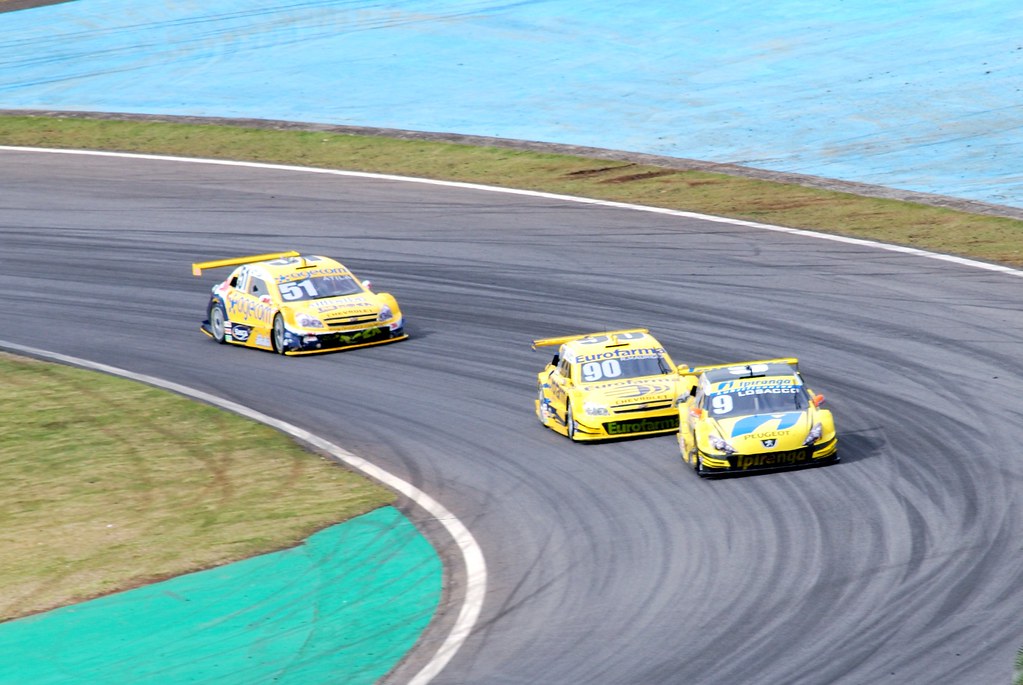
The slightly clunky, tyre-lined chicane was further altered for the 2013 season, with the exit curve slightly eased to make it faster, while 2016 saw it narrowed with the addition of 'sausage' kerbs to prevent corner clipping. Inevitably these tore up the cars and were extremely unpopular, so ahead of the Grand Final race of the 2017 a completely new design was installed, featuring a much larger and slower chicane design. It was used in combination with specially-designed SAFER barriers, identical to those now widely used on North American ovals, which had replaced the concrete wall at the Café corner.
The new chicane saw use for one year before further evaluation by the Brazilian Automobile Confederation (CBA) concluded safety levels on the Stock Cars had advanced to a point that it was not necessary.
"Now, after a careful evaluation by the Racetrack Commission, understanding the speed, escape area and distance from the walls there, we decided to return the original layout," Stock Car director of engineering Mirnei Antônio Piroca told Motorsport.com. "But it was mainly due to the increased safety of Stock Car cars that this was released. We used the chicane until the end of last year, everyone remembers. And for this year this layout was approved."
The chicane remains in use for the junior Stock Light category, due to the older machinery and lower safety systems employed on these cars.
Major refurbishment leads to new pit complex
Plans for a new Formula One only pit lane on the Reta Oposta straight were unveiled in 2012, though were finally discounted after circuit bosses feared it might spoil some of the essential character of the track. Instead, a $60 million refurbishment programme was launched, which saw major civil engineering works begin in August 2014 to create a new pit lane entry and exit. The hillside at the back of the Laranjinha was built up with a concrete wall, allowing more space above for a revised pit lane entry.
Additional run-off was also created at the Senna-S by moving the pit lane exit further back, while further earthworks created more room to the outside of Curva do Sol. The final track change came with the addition of an alternate route at Bico de Pato, possibly for use during motorcycle events, though this does not seem to have ever been used. The works, including a full track resurfacing, were completed ahead of the Grand Prix in November, with a second phase due to start following the race. This saw the existing pit buildings demolished and new ones built, with increased garage and paddock space. A reduced calendar of events was run in 2015 with a temporary pit lane employed while the construction work took place.
The most recent improvements came in 2018, when the circuit received night lighting throughout its length. Twenty-one towers were installed, one approximately every 200 meters. Each tower is nine meters high and the lamps used are 140,000 lumens, twice the average, which means an actual lighting power of 150 linear meters. They are flexible and pivot to allow light to be directed to points of interest as needed.
Formula 1 race safeguarded from Rio threat
The future of the circuit as the host of Formula One beyond 2020 seemed in doubt, with a new F1-standard circuit in Rio de Janeiro announced in 2019 with the backing of the country's president, Jair Bolsonaro. While this could have been a terminal blow, the news had the unexpected bonus of galvanising the support for Interlagos from the city's officials. In May 2019, plans to sell off the circuit as part of a drive to privatise city real estate were shelved, with city councillors voting to renew the circuit's concession instead.
Following the cancellation of the 2020 Brazilian Grand Prix due to the COVID-19 Pandemic, along with other planned events such as the FIA World Endurance Series, the uncertainty about the future of Interlagos as a host of world-level events continued. However, in November 2020, with the Rio circuit plans seemingly in tatters, the governor of the State of São Paulo confirmed a new contract had been agreed with Formula 1, keeping the Grand Prix at Interlagos until at least 2025.
The Formula One race was renamed the São Paulo Grand Prix from 2021, following a change of promoter and a new commercial arrangement with Formula 1. A new five-year deal signed in November 2023 secured the São Paulo Grand Prix at Interlagos until the end of the 2030 season, superseding the previous arrangement that had run through 2025.

Jump onboard
Circuit info
- Autódromo José Carlos Pace, Av. Senador Teotnio Vilela, 261 São Paulo, Brazil
- +55 11 5666-8822
- Email the circuit
- Official website
Rate This Circuit
Votes: 9024
Plan a visit
Planning a visit to Interlagos? Find the best deals near to the circuit on hotels, apartments and rooms to rent from the map or click the buttons below for the best deals on flights and car hire.
The Autódromo José Carlos Pace is located in the southern region of São Paulo, in the Interlagos district. The nearest international airport is São Paulo-Guarulhos, 30 miles to the north east, approximately 45 minutes from the track. Congonhas Airport is closer to the circuit, offering domestic connections and private flights.
Travelling to the circuit by public transport is relatively straightforward. Located approximately at six minutes of walk far, the Autódromo Station (Line 9 – Esmeralda / Osasco-Grajaú) is an alternative for those who want to escape traffic and travel by train. There are also numerous buses routes to the circuit - check the circuit website for details.
For those who do wish to drive, the track is located close to Marginal Pinheiros and Av. Senador Teotônio Vilela. Parking is free, though there may well be restrictions during event weekends.
Find cheap flights Book affordable car hireGet directions
Current Conditions
0°C
Feels Like: 0°C
Humidity: %
Wind: Calm, m/s
Direction: Towards N

0%