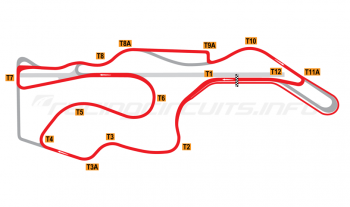
Autódromo Ciudad de Concordia
 Flag of Argentina


Circuit Overview
Autódromo Ciudad de Concordia is a permanent racing facility nestled in the Argentine province of Entre Ríos, serving as a key fixture in national-level motorsport.
It plays host to Argentina’s premier touring car championships, including Turismo Carretera and TC2000, and is notable for its flowing, anti-clockwise layout with multiple configurations.
With modernised infrastructure and proximity to the Uruguay River, the venue combines natural scenery with competitive motor racing.

Circuit History
The Autódromo Ciudad de Concordia was the first asphalted racing circuit in the province of Entre Ríos. Constructed by the Concordia Automóvil Club replaced an earlier compacted dirt layout used for regional events in the 1960s.
According to contemporary reports, the final race on the old dirt course was held in late 1968. At that point, the club’s leaders made a commitment to open the 1969 season on a modern, paved facility. Construction began on 22 January 1969, relying on volunteer labour, donated equipment and significant local support. The work was completed within just 20 days—an impressive feat that culminated in the venue’s inaugural asphalt event on 4 May 1969.
“With humility and determination, the directors of the club gave Concordia a circuit worthy of its community and its passion for motorsport,” noted the press at the time.
This inaugural version was basic but functional, with modest pit facilities and no formal grandstands. Nonetheless, it immediately elevated the profile of motorsport in the Mesopotamia region of Argentina. The venue became a mainstay of regional championships and a training ground for emerging national talents.
Evolution and expansion
A 700-metre (0.435-mile) extension was laid in 1971, aiming to create a longer configuration. However, this layout was never officially used in competition, and the circuit reverted to its original loop for the following years.
The 1980s saw continued use by zonal and national categories, but as racing standards evolved, pressure grew for modernisation. A major overhaul was undertaken in 1992, marking one of the most significant transformations in the circuit’s history. The direction of travel was reversed to clockwise, and a new pit lane was constructed on the opposite side of the track. These changes brought the layout closer in line with contemporary expectations and reopened opportunities for top-tier championships.
From this point, Concordia became a regular fixture on calendars for Turismo Nacional, TC2000 and Formula 3 Sudamericana, with the revised 3.150 km (1.957 miles) configuration forming the backbone of the circuit’s new identity.
The 2014 redevelopment
In response to both safety demands and competitive needs, the circuit was significantly expanded in 2014. The “Gran Premio” configuration extended the lap to 4.700 km (2.920 miles), while an intermediate 3.120 km (1.939 miles) layout was also introduced to retain versatility. Modernisation efforts included resurfacing, improved safety barriers, a new paddock complex and infrastructure upgrades that met FIA Grade 3 standards (though have not been formerly homologated by the FIA).
This redevelopment enabled the return of Turismo Carretera, Argentina’s premier racing series, which now considers Concordia a key venue on its calendar. The new layouts also prompted praise from drivers. “Tiene un ritmo europeo” (“It has a European rhythm”) became a common refrain, particularly after TC2000 tested the Grand Prix loop in 2014. Drivers noted the flowing corner sequences, high-speed transitions and natural terrain undulations as reminiscent of classic tracks like Estoril or Jerez.
A living legacy
On 18 May 2019, Concordia celebrated its 50th anniversary, reaffirming its role not only as a place for racing but as a communal meeting point. As local press reflected, the circuit has grown not only in physical size and prestige but in the hearts of the community:
“What began as a dream full of hope, engines and hard work has become an icon of national motorsport—growing in infrastructure, in prestige, and above all in the hearts of the people of Concordia.”
Wildlife occasionally makes its presence known near the rural complex, and the small airstrip visible alongside the back straight remains an enduring feature of the venue’s unique geography. But the real story of Concordia is of endurance, adaptability and shared passion—a circuit born of community willpower and still driven by it today.
Jump onboard
Circuit info
- Autódromo Ciudad de Concordia, Av. Monseñor Ricardo Rösch S/N, 3200 Concordia, Entre Ríos, Argentina
- Official website
Rate This Circuit
Votes: 910
Plan a visit
Planning a visit to Autódromo Ciudad de Concordia? Find the best deals near to the circuit on hotels, apartments and rooms to rent from the map or click the buttons below for the best deals on flights and car hire.
Concordia is located in the province of Entre Ríos, around 430 km (267 miles) north of Buenos Aires. The nearest commercial airport is Aeropuerto de Concordia (Comodoro Pierrestegui Airport), just 20 minutes’ drive from the circuit, though flight services can be limited. More frequent connections are available via Paraná or Buenos Aires, with car hire advised for convenience.
By road, the city is accessible via National Route 14, a major north-south artery. Ample parking is available on-site, and race-day access is well managed, especially during Turismo Carretera events. While public transport options are limited, Concordia’s compact city layout means taxis and local buses can reach the circuit from the city centre with relative ease.
Get directions
Current Conditions
21°C
Light rain
Feels Like: 22°C
Humidity: 99%
Wind: Light air, 3.52 m/s
Direction: Towards S

0%
Five Day Forecast
Sun
Oct 25
Overcast clouds
17°C / 11°C
0%
Mon
Oct 26
Broken clouds
19°C / 8°C
0%
Tue
Oct 27
Broken clouds
21°C / 11°C
0%
Wed
Oct 28
Overcast clouds
23°C / 12°C
0%
Thu
Oct 29
Overcast clouds
20°C / 20°C
0%