Toronto, Exhibition Place
 Flag of Canada


Circuit Overview
For almost four decades, IndyCar’s Toronto street race around Exhibition Place and Lake Shore Boulevard was one of the championship’s signature city events. Run on a fast, flowing temporary course framed by grandstands, arenas and landmark architecture, it became a summer fixture in Canada’s largest city and a standout stop for drivers and fans alike.
The Toronto race was IndyCar’s second-longest running street event behind Long Beach, appearing regularly from 1986 through to 2025 with notable interruptions: the 2008 cancellation following the open-wheel reunification and the pandemic-driven cancellations in 2020 and 2021.
After the 2025 event, it was confirmed the weekend would relocate to a new purpose-built street circuit in Markham from 2026, bringing the Exhibition Place era to a close.
Circuit History
Proposals for a race in the area were first mooted in the mid-1970s, using a portion of Lakeshore Boulevard slightly further to the west. These came to nothing and it wasn't until Montreal began hosting Formula One on Île Notre-Dame that civic and corporate pride came into play to ensure the race was finally organised.
The Molson Brewing Company was keen to have an event to rival the F1 race, which was sponsored by Labatt's, while Toronto's city leaders were keen on gaining some one-upmanship on Montreal. With IndyCar looking for an alternative to the unpopular Sanair oval, the ingredients quickly came together and the Molson Indy Toronto event was born.
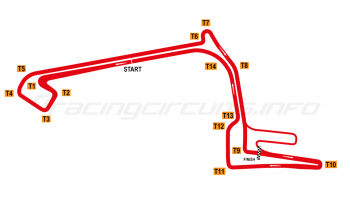
The resulting course, first used in 1986, made the most of Exhibition Place’s broad roads and the sweep of Lake Shore Boulevard. It offered a rare street circuit rhythm: relatively smooth surfaces, quick changes of direction and long periods at speed, all while threading between buildings and stadium infrastructure. At the opening corner, cars turned in by the ceremonial arch of Princes’ Gates before accelerating along Lake Shore on the main straight, creating one of the event’s most recognisable visual signatures.
Did you know?
Among the buildings forming the backdrop to the track was Exhibition Stadium, located immediately behind the pits. The stadium has a long history, being used for football and baseball, but what is often overlooked is its own brief flirtation with motorsport history.
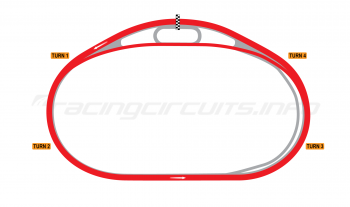
In 1952, a 1/3-mile paved oval was inserted into the stadium and a 'golden era' of short course racing began.With the large grandstand providing an elevated viewing point, the events proved an immediate hit and crowds of 20,000 were not unusual.
The stock cars remained popular throughout the 1950s and the drivers became heroes. Then in 1958 came the event that saw it claim a slice of NASAR history, when the Grand National Series (now Sprint Cup) rolled into town. Among the starters was a 21-year-old Richard Petty, making his main series debut. He ran well until being shown the 'chrome horn' by his own father, Lee, who went on to win the race...
The NASCAR stars never returned – there was more interest from the fans for the local stars – and racing continued for several years until complaints from the Toronto Argonauts football team that their pitch was being damaged by errant race cars called a halt to proceedings. The asphalt was torn up and converted to a cinder track and the engines fired up no more.
Toronto becomes a modern classic
The inaugural race, staged on 20 July 1986, immediately established Toronto as a major draw. Over the next two decades the circuit became a familiar battleground for CART and later Champ Car, with Michael Andretti emerging as the event’s defining specialist through his record run of victories on the streets around Exhibition Place.
A significant layout change arrived in 1996 amid construction of the National Trade Centre, with revisions that altered the flow into the lap’s closing sector. That year also remains one of the darkest in the circuit’s history, when Jeff Krosnoff and volunteer marshal Gary Avrin were killed in an accident at the end of Lake Shore Boulevard, an incident that shaped the event’s safety story for years afterwards.
The setting around the track continued to evolve. Exhibition Stadium, a long-time backdrop along the route, hosted its final moments as a sports venue in the 1990s and was ultimately replaced, with BMO Field later rising on part of the site. Once again, IndyCars found themselves racing past a major sporting arena, reinforcing the circuit’s distinctive “event within a venue” feel as Exhibition Place developed around it.
Reunification, cancellation and return
In 2007, Toronto entered a new commercial era as Molson’s long association ended and Steelback took over as sponsor. However, the February 2008 reunification of Champ Car and the Indy Racing League left Toronto without a slot, and the 2008 race was cancelled. The assets were subsequently purchased by Andretti Green Racing, and the event was confirmed to return in July 2009 under Honda title sponsorship, restoring Toronto to the top-level calendar and ushering in a new IndyCar-period identity.
The modern Toronto weekend remained a major draw, but the practical realities of staging a street race in a living exhibition complex meant periodic revisions were inevitable. A notable change came for 2016, when construction and site constraints prompted a relocation of the pit lane. IndyCar’s pits moved to the north side of the circuit, starting at Turn 9 and running back along Princes’ Boulevard past Turn 11, with hospitality also shifting to the new pit side and a new pedestrian and wheelchair crossing added at Turn 9.
Title branding shifted again in 2024, when Ontario Honda Dealers became the event’s title sponsor and the weekend was renamed the Ontario Honda Dealers Indy Toronto.
By its final seasons, Toronto continued to show the trademark strengths and weaknesses of a high-speed street layout. In 2025, drivers complained of a pronounced bump in the heavy braking zone for Turn 3 on Lake Shore Boulevard, prompting overnight repairs and new asphalt applied to the braking area during the race weekend.
The end of the Exhibition Place era
Although the event returned strongly after the pandemic cancellations in 2020 and 2021, long-term certainty at Exhibition Place became increasingly constrained by competing demands on the site. When the move to Markham was announced in September 2025, the hosting of the 2026 FIFA World Cup at BMO Field, located within Exhibition Place, was explicitly cited as a catalyst, alongside broader redevelopment pressures and the risk of losing the event altogether if it took a year away from the calendar. The 2025 weekend therefore marked the final IndyCar running on the Exhibition Place streets, bringing a chapter that began in 1986 to a close.
Jump onboard
Circuit info
This is a historic circuit which is no longer in operation.
Rate This Circuit
Votes: 8529
Location Information
Exhibition Place sits on Toronto’s waterfront immediately west of the city centre, between Lake Shore Boulevard and Ontario Place. It remains a major visitor destination, with a mix of historic buildings, museums, arenas and open public grounds that are easy to explore on foot.
Public transport is the simplest way to reach the site. Exhibition Place has its own commuter rail stop (Exhibition GO) and is also served by frequent streetcar and bus services linking directly with central Toronto. Once you arrive, the grounds are largely flat and walkable, with wide internal roads and pedestrian routes that make it straightforward to trace sections of the former street circuit.
Several recognisable motorsport landmarks are still in place. Princes’ Gates, the ceremonial arch that formed the visual signature of the old Turn 1 area, remains the most distinctive reference point on the grounds. Lake Shore Boulevard continues to define the southern edge of the site, while the sporting venues that framed the event atmosphere, including BMO Field, remain prominent features of the modern Exhibition Place landscape. Beyond circuit history, visitors can explore the broader Exhibition Place complex and the adjacent Ontario Place waterfront, with what is accessible on any given day shaped by the site’s busy calendar of shows, sporting fixtures and exhibitions.