Hungaroring
 Flag of Hungary


Circuit Overview
The Hungaroring holds the distinction of being the first venue for Formula One behind the former 'Iron Curtain', having hosted top level racing continuously since 1986.
Criticised for being overly tight and twisty, the track has undergone several modifications to improve overtaking, including the removal of a chicane in 1989 through to a more extensive rebuild in 2003.
While the circuit may originally have been built for Formula One, today the Hungaroring also hosts a diverse range of other events, including the International GT Open, TCR Europe and the Formula Regional European Championship.

Circuit History
Motorsport has a long tradition in Hungary with races being organised on a street circuit in the Népliget park in Budapest as far back as the 1930s. In 1936, the Budapest Grand Prix was held at the circuit, Tazio Nuvolari winning in an Alfa Romeo.
After the Second World War, racing was slow to resume, but eventually engines fired up again, this time around an improvised course at Budapest's Ferihegy Airport. Formula Junior continued at Ferihegy for three years, before racing switched back to Népliget, continuing there into the 1970s.
By the 1980s, authorities were keen to promote tourism and raise the profile of the country through motor racing and talks began about hosting a Formula One race. The Népliget circuit was initially proposed, with the idea of creating a Monaco-style street race. However, this was soon rejected in favour of a modern, purpose-built facility.
A site 11 miles north east of Budapest near to the town of Mogyoród was soon identified as offering a number of advantages; it was close to the capital, alongside a major motorway and set in a natural bowl, allowing spectators good views of most of the facility from any vantage point.
Construction work started on October 1, 1985 and was completed in just eight months; at the time considerably less time than any other Formula One circuit had taken to construct. The initial layout had to be modified during construction when an underground spring forced the diversion from the planned course via a series of slow S-bends, slowing the lap considerably.
The first race was held on March 24, 1986, in memory of János Drapál, the Hungarian four-time Motorcycle Grand Prix winner who had been killed the year before in a race in Czechoslovakia. Later that year came the first F1 race, won by Nelson Piquet in front of a crowd of almost 200,000 enthusiasts from across the Eastern Bloc countries, Germany and Austria.
The event was undoubtedly a success, even if the track was less enthusiastically received by the drivers. The tight and twisty nature of the course was compounded by a slippery track surface – a lack of general use throughout the year plus the bowl-like nature of the landscape meant dust was always a problem. Some enjoyed driving the course, others detested it; all could agree, however, that overtaking was at a premium. Nevertheless, Nigel Mansell memorably proved it was possible in the right circumstances, pouncing on momentary hesitation from Ayrton Senna while lapping a backmarker to sweep around the outside and drive on to victory in 1989.
Changes were made to the track in 1989, when the issues with the underground spring were finally resolved and the clumsy S-bends behind the pits were bypassed. Then, for the 2003 season, more fundamental changes were made when the final series of bends and the pit straight were altered, in order to provide a longer pit straight. A new, tighter, first corner does offer slightly more scope for overtaking and the racing has improved somewhat.
The entire circuit was resurfaced over the winter of 2015/16, which involved the removal and relaying of a top section of asphalt to a depth of between three and five centimetres around the entire 4.381-kilometre lap.
As well as the major resurfacing work, the kerbs at Turn 4 and Turn 11 were modified to make the track better suited for motorbike racing.
Rebuilt for a 40th anniversary
In July 2023 Formula 1 extended the Hungarian Grand Prix's contract to 2032, replacing a deal that ran to 2027. The extension came on the condition that the circuit was fully renewed by the 2026 race. What followed was the most extensive redevelopment since the Hungaroring opened in 1986, carried out in phases around the annual Grand Prix.
The first phase was finished before the July 2024 race. The paddock was widened, two tunnels were built beneath the start/finish straight, the old lower depot buildings were demolished and the finish straight was resurfaced. Work on the second phase began a week after that Grand Prix and ran until June 2025. It delivered a new main pit building, with 36 team garages, four technical garages, a VIP area for 2,000 guests, offices and a roof terrace, alongside a new covered main grandstand seating 10,000. Both were in use for the 2025 Grand Prix, although the pit building was then finished only on the outside. Race control and the media centre moved into their permanent home for the 2026 race. The circuit's chief executive, Zsolt Gyulay, said in February 2026 that the Hungaroring was still far from finished and that later phases depend on funding. He said completing them could allow the contract to be extended to 2037.
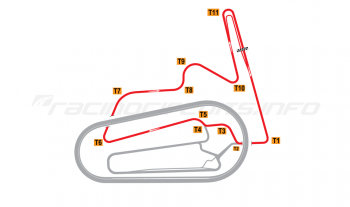
The 2026 Hungarian Grand Prix, held on July 26, was the 41st in an unbroken run since 1986 and fell in the circuit's 40th-anniversary year. To mark the occasion, the Hungaroring officially named all 14 of its corners. Turn 1 is Piquet, Turn 2 Hamilton, Turn 3 Spring, Turn 4 Mansell and Turn 5 Mogyoród. Turns 6 and 7 are Driving Center and Turns 8 and 9 Buda/Pest. Turn 10 is Danube, Turn 11 Alesi, Turn 12 Schumacher, Turn 13 Senna and Turn 14 Szisz. Lando Norris won the race from pole position for McLaren, ahead of Max Verstappen and Kimi Antonelli.
Jump onboard
Circuit info
- Hungaroring Circuit, 2146 Mogyoród, Hungaroring út 10, Hungary
- +36 28 444 444
- Email the circuit
- Official website
Rate This Circuit
Votes: 8715
Gallery
The latest images from Hungaroring.


Plan a visit
Planning a visit to Hungaroring? Find the best deals near to the circuit on hotels, apartments and rooms to rent from the map or click the buttons below for the best deals on flights and car hire.
The Hungaroring track is situated 20 kilometres north of Budapest, alongside the M3 motorway. The nearest international airport is Budapest's Ferenc Liszt International Airport, 24 kilometres south east of the city and approximately half-an-hour's drive from the circuit. It has flights from all the major European cities, as well as some in North America.
If you are not hiring a car for the weekend you can catch the airport minibus service into the city or take a taxi. For getting around town, there are four metro lines and an extensive tram network.
On F1 race weekends, the official City Shuttle runs to the circuit from Olof Palme sétány in Városliget, near Heroes' Square, from 7am to 8pm, Friday to Sunday (in 2026 a single cost €25 and a return €38). The H8 suburban railway (HÉV) also runs extra services, with a free shuttle from Kerepes station to Gate 3. A dedicated lane on the M3 motorway is reserved for Főtaxi, the circuit's official taxi partner. For those driving, parking for cars is free in car parks P1 to P3, while coaches pay €85 a day (2026 prices).
Find cheap flights Book affordable car hireGet directions
Current Conditions
7°C
Clear sky
Feels Like: 5°C
Humidity: 90%
Wind: Light air, 3.09 m/s
Direction: Towards E

0%
Five Day Forecast
Sun
Oct 25
Light rain
14°C / 6°C
52%
Mon
Oct 26
Light rain
13°C / 5°C
100%
Tue
Oct 27
Scattered clouds
13°C / 3°C
0%
Wed
Oct 28
Clear sky
14°C / 3°C
0%
Thu
Oct 29
Overcast clouds
4°C / 4°C
0%