Balaton Park
 Flag of Hungary
Circuit Overview
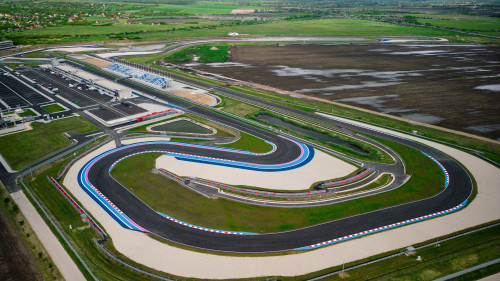
Balaton Park Circuit is bidding to be Hungary’s second permanent circuit to break through onto the international motorsport stage.
Located in a popular tourist area near Balaton Lake, 90km south west of capital city Budapest, the circuit has been built to FIA Grade 1 standards, though initially is seeking only homologation at Grade 2 level.
The track boasts grandstands that seat 10,000 that can be supplemented with bleachers to give a total capacity of up to 120,000 spectators. With an on-site 145-room four star hotel overlooking the circuit, the facility is certainly providing international promoters with a venue that is worthy of attention.

Circuit History
Plans for a circuit near to Balaton Lake were first announced in the early 2010s, with investors keen to bring motorsport to the region, given its close proximity to Austria, Slovenia and Croatia, expanding its potential user base and taking advantage of the existing and well developed tourism industry.
The lake itself is among Hungary’s most popular holiday destinations and attracts visitors from all over the world, while the nearby town of Balatonfüred is famous for its beautiful promenade, parks, spas and thermal springs.
Balaton Park is in fact the second attempt to establish a motorsports facility in the region. A separate facility, known as the Balatonring, had gained approval and construction had in fact begun when it was announced that the circuit would feature on the 2009 MotoGP calendar. Sadly, that project experienced construction delays which postponed the race to 2010, before the after effects of the global financial crisis caused the whole project to collapse into financial ruin, never to be completed.
Happily, the backers behind Balaton Park had better financial acumen and, after a decade of planning, began constructing their €200m facility in 2015. Heading the organisation which has brought the project to fruition is former International Formula 3000 racer and one-time F1 practice entrant Chanoch Nissany, father of current Formula 2 racer, Roy Nissany.
Built to the highest standards
Construction took place over the following years, with completion in May 2023. The track was designed by Hungarian engineer Ferenc Gulacsi, who set three key principals for its design; safety, driver challenge and sustainability. It certainly meets the first criterion, being built in accordance with the highest standards laid down by the FIA and FIM. In theory, this means the track could be eligible to host Formula One races, though the circuit is currently only looking to initially homologate the track to FIA Grade 2. Given MotoGP’s previous interest in the region it would not be a surprise if the track was also certified at FIM Grade A standard.
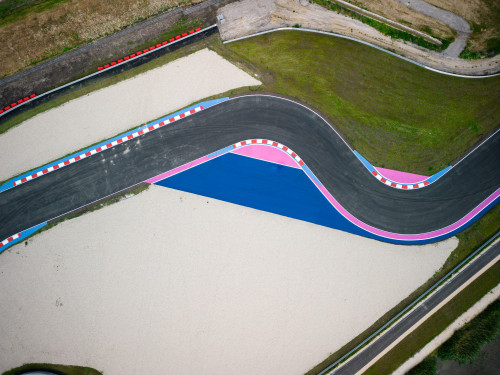
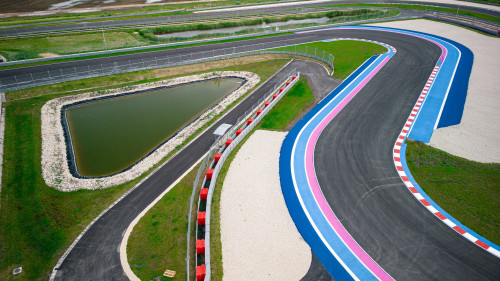
The completed track boasts the latest in circuit infrastructure. The race control features a fully integrated solution to control all the action happening on the track, using real-time data (GPS location, vehicle data) and linked to the FIA/FIM standard LED marshalling panels. The track also boasts Tec-Pro barriers in all the major run-off areas, with no tyre barriers used on the site at all.

The facilities include 48 pit garages, spacious VIP areas and lounges including fine catering services, a large media centre, a medical centre, and two additional support paddock areas. A large main grandstand overlooks the start finish straight and pits, providing permanent seating for 10,000 fans, but this can be increased to 120,000 with the erection of temporary grandstands.
Meanwhile, accommodation needs for those visiting the circuit will be catered for by the 145-room 4-star hotel with a direct view over the circuit is set for completion, outside the final turn complex.
Layout wins praise from F1 winner
Time will tell if the 16-turn, 2.56 mile layout provides the sort of challenge that its designer hoped for, though former Grand Prix winner Giancarlo Fisichella was on hand at the track’s opening event in May 2023 and gave it initial praise.
“Driving Balaton Park Circuit for the first time, I was impressed by its character,” he said. “The track really has it all – a thrilling blend of high-speed corners, challenging hairpins and cool chicanes.
“It’s a track that flows nicely, giving you a great racing feeling.
“The first corner and the end of the back straight are prime spots for overtakes. All in all, Balaton Park is a treat to drive.”
First events include major manufacturer support
The circuit’s first major event will celebrate Porsche’s 75th anniversary with a two-week driving programme entitled ‘Porsche on Track’, followed by a one-day ‘Festival of Dreams’ event on June 10.
Competition motorsport will began later in the year when Balaton Park hosts the final round of the ACCR Czech Formula 4 series that covers Central Europe on October 6-8.
Beyond this, it is clear that the track has much higher aspirations and numerous international championships are set to watch the circuit’s progress with interest.
Jump onboard
Circuit info
- Balaton Park Circuit, Balatonfőkajár, Reptér, 8164 Hungary
- Email the circuit
- Official website
Rate This Circuit
Votes: 1679
Gallery
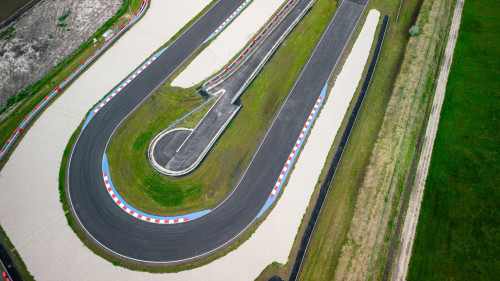
The latest images from Balaton Park.
Plan a visit
Planning a visit to Balaton Park? Find the best deals near to the circuit on hotels, apartments and rooms to rent from the map below.
Tip: You can also find the best local restaurants and deals on other nearby attractions by clicking on the logo in the top left of the map.
Balton Park Circuit is located at Balatonfőkajár in Hungary. The nearest international airport is Budapest, around 1h 15m away by car.
The circuit is located just south of the town of Balatonfőkajár, a short distance from Lake Baloton. It is easily reached from the motorway network.
From Budapest and the north east, take the M1 motorway westbound, then join the M7 motorway (E71) heading south. After around 80km, take exit 90 towards Veszprém/Balatonfüred, onto Route 710 headed north. At the next roundabout, take the first exit to the right and then turn right again after 400m and the road will take you to the main entrance.
Coming from the south-west (Slovenia/Croatia), taker the M7 motorway, and exit at junction 90 towards Balatonfüred. Turn left at the next junction and continue straight on Route 71 for 3km. After passing a petrol station on your right, turn right at the roundabout. After 1km, go straight ahead at the next roundabout and then turn right after 400m and the road will take you to the main entrance.
Coming from north (Austria), take Route 710 until the last roundabout before the M7. Take a left turn there and then turn right after 400m, and the road will take you to the main entrance.
The track can also be accessed by public transport. Take bus no. 7323 from Balatonakarattya railway station to Balatonfőkajár tüzép station. From there, it’s just a 1.3 km walk to the circuit.
Get directions
Current Conditions
13°C
Overcast clouds
Feels Like: 12°C
Humidity: 62%
Wind: Light air, 3 m/s
Direction: Towards N

0%
Five Day Forecast
Sat
Apr 20
Broken clouds
12°C / 5°C
0%
Sun
Apr 21
Overcast clouds
9°C / 4°C
0%
Mon
Apr 22
Overcast clouds
9°C / 4°C
0%
Tue
Apr 23
Overcast clouds
9°C / 5°C
0%
Wed
Apr 24
Light rain
14°C / 6°C
100%
Get your race tickets!
Brought to you with: 
We've teamed up with Motorsports Tickets to bring you the best deals for Formula One, MotoGP, Le Mans and more.