Motopark Raceway
 Flag of Finland
Circuit Overview
Motopark Raceway is one of Finland's more unusual motorsport venues, combining the country's first purpose-built drag racing strip with a challenging road course set among the forests and lakes of southern Savo.
Opened in 1987 on the site of a former copper mine near Virtasalmi, Motopark was initially developed exclusively for drag racing. A 2.185-mile (3.516 km) road circuit was added in the early 1990s, winding around the original quarter-mile strip and making use of the varied terrain left behind by the mining operations.
Today, Motopark remains an important venue for Finnish motorsport, hosting national drag racing and motorcycle racing championships, alongside endurance events and track days. Its activities are, however, subject to strict noise restrictions following a lengthy series of disputes with nearby residents.

Circuit History
The origins of Motopark Raceway lie in the former Hällinmäki copper mine, which operated on the site between 1966 and 1984. Initially worked as an open pit until 1972, mining subsequently continued underground until the operation finally closed. The waste ground was covered with soil, while the abandoned open pit gradually filled with water, creating the lake which can still be seen alongside the circuit's paddock.
Following the mine's closure, the land was acquired by local gravel contractor Pasi Häkkinen, whose quarrying business continued to operate on neighbouring land. It was this acquisition which would eventually provide the opportunity to establish a permanent home for Finland's growing drag racing scene. The impetus for the project came from the Pieksämäki Hot Rod Association, established in nearby Pieksämäki on 4 October 1986. The club, which continues today as USA Car Club Pieksämäki, was instrumental in bringing together the individuals responsible for developing the new venue.
Four men are generally credited with Motopark's creation: club chairman Jari 'Patu' Kaplas, landowner and contractor Pasi Häkkinen, Finnish Hot Rod Association (FHRA) chairman Risto 'Paha Paavali' Poutiainen and Antti Puranen of the Paproe design office, who was responsible for the original track design. Planning began during the winter of 1986–87, with construction getting under way the following spring. Work progressed rapidly, allowing the new facility to open for competition just months later. A dedicated operating company, Motopark Oy, was also established during 1987.
Finland's first purpose-built drag strip
Motopark's opening represented an important milestone for Finnish drag racing. Although the sport had been established in the country since the first officially sanctioned events at Keimola in 1975, competitors had previously been reliant on temporary facilities, principally at airfields such as Räyskälä and Seinäjoki.
The new venue was designed along American lines, with a permanent quarter-mile drag strip constructed across the former mine's waste ground. It hosted its first Finnish Championship event in late June 1987, becoming the country's first dedicated drag racing facility. Indeed, according to the FHRA, Motopark was not only unique in Finland but was also the only motorsport stadium in Europe constructed specifically for drag racing at the time.
While drag racing was initially the principal activity, the venue soon began attracting interest from other branches of motorsport.
Among the first to make use of the facilities was the Imatra Motor Club, organisers of the famous Imatranajo motorcycle races. Following the closure of the historic Imatra street circuit after the 1986 event, the club sought alternative venues to continue its activities. A national-level meeting was subsequently organised using the Motopark drag racing area, before the championship races moved to Jurva. The association with the Imatranajo would nevertheless prove an enduring one.
Development of the road circuit
During the early 1990s, plans were put in place to expand Motopark into a more comprehensive motorsport facility. The most significant addition was a permanent asphalt road circuit, constructed around the existing drag strip and making use of the contours of the former mining site. A separate gravel rally course, measuring approximately 1.864 miles (3 km), was also developed around the perimeter of the complex during the same period.
Work appears to have taken place between 1991 and 1993, although the precise completion date remains uncertain. The asphalt circuit was certainly operational by the summer of 1993, when the Imatranajo motorcycle races returned to Virtasalmi.
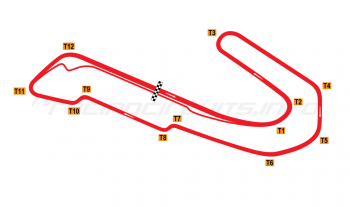
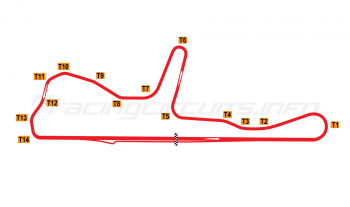
Measuring 2.185 miles (3.516 km), the anticlockwise road course has a relatively straightforward overall shape, although its northern section is considerably more technical than might initially appear. Two long straights run roughly parallel to one another, with the drag strip and pit facilities occupying the space between them. At the southern end, close to the road towards Juva, the circuit turns through a tight hairpin before heading back in the opposite direction.
The northern end is altogether more complicated, with a sweeping outer section leading into a series of tighter corners and changes of direction across the former mine workings.
The circuit is also surprisingly undulating, with approximately 15 metres separating its highest and lowest points. Several blind crests add to the challenge, while the long main straight, which features a gentle kink, allows cars to reach speeds in excess of 120 mph (193 km/h).
At just 11 metres wide for much of its length, increasing to 12 metres along the start straight, Motopark is comparatively narrow by modern standards. Nevertheless, its combination of fast sections, technical corners and elevation changes has made it a popular venue among competitors. Remarkably, the original road circuit layout has remained unchanged since its completion.
Motorcycle racing becomes established
With the completion of the road circuit, motorcycle racing quickly became a major part of Motopark's activities. The Imatranajo returned in 1993 and became a regular fixture, continuing at Virtasalmi for more than two decades. Its most notable meeting came on 14 July 1996, when the 32nd running of the event incorporated the Nordic Superbike Championship. The championship was decided over a single race, held in wet conditions, with Finnish rider Erkka Korpiaho emerging victorious.
Motopark also became an established venue for the Finnish Road Racing Championship, with meetings recorded from at least 1998 onwards. The circuit has continued to feature regularly on the national calendar, including rounds of the Finnish Superbike Championship.
International motorcycle racing also made occasional appearances. On 23–25 August 2002, the circuit hosted a meeting of the Union Européenne de Motocyclisme (UEM) classic road racing series, with the event returning for a further meeting in August 2004.
The Imatranajo continued at Motopark until 2014, after which the event transferred to Pärnu in Estonia for 2015, bringing an end to its long association with the Virtasalmi circuit. Motorcycle racing subsequently returned to the historic Imatra street circuit, although Motopark continued to host national championship events.
Despite the departure of the Imatranajo, motorcycle racing has remained an important element of the venue's calendar. In more recent years, the circuit has continued to host national superbike and other motorcycle racing categories, with Finnish rider Niki Tuuli establishing a new superbike lap record of 1 minute 23.983 seconds aboard a Kawasaki ZX-10R on 18 June 2023.
Car racing and drag racing
Although motorcycle competition has accounted for much of Motopark's road racing activity, the circuit has also hosted a variety of car racing events. Among the more notable was a visit by the Finnish Formula 3 Championship on 18–19 May 2002, when the circuit staged the third and fourth rounds of the season. Both races were contested over 12 laps, with Aki Rask taking victory in the opening encounter. Driving a Dallara F394, Rask also established the fastest lap at 1 minute 22.139 seconds.
The second race produced a different winner, with Sanna Pinola taking the chequered flag.
Other car racing activities have included endurance competitions and historic racing meetings, with the circuit's relatively compact layout providing a suitable setting for a variety of machinery.
Meanwhile, the original drag strip has continued to fulfil the purpose for which Motopark was first established. FHRA Finnish Championship events have been a regular feature since the inaugural meeting in 1987, maintaining the venue's position as one of the country's principal drag racing facilities. The circuit celebrated its 30th anniversary in 2017, with a Finnish Championship drag racing meeting held over the weekend of 10–11 June.
During the early 2000s, the calendar also included a Midsummer 'Drag & Rock' event, combining drag racing with musical entertainment.
Changes in ownership and management
The development of Motopark has been accompanied by several changes in the companies responsible for operating the venue. The original Motopark Oy remained registered until 2005, although operational control had passed to Mevitar Oy by the turn of the millennium.
Under the leadership of John Tuuli, Mevitar oversaw the circuit's activities throughout much of the 2000s, a period during which the venue's relationship with neighbouring residents became an increasingly significant issue.
A further change followed in January 2010, when ZWO Oy was registered at the circuit's Motoparkintie address.
ZWO subsequently became the venue's operator and, in 2018, formally registered Motopark Raceway as a trade name.
Environmental restrictions and noise disputes
Like many permanent motor racing circuits, Motopark has faced difficulties over noise emissions, particularly given the proximity of residential properties, some of which lie just 400 metres from the track.
Concerns among local residents increased following the construction of the road circuit during the 1990s, with opposition eventually organised through the Pro Hällinmäki residents' association. The group argued that the expansion had taken place without the necessary environmental permissions, leading to a lengthy dispute involving environmental regulators and the Finnish courts.
On 19 August 2003, the South Savo Environment Centre granted Motopark an environmental permit restricting the number of days on which noise levels could exceed 55 dB(A) at nearby homes. Following a series of appeals, the permit came into effect around 2005, allowing louder activities on eight days and one weekend per month, with a complete prohibition during July.
The restrictions failed to resolve the dispute, however, with repeated breaches recorded during 2008 and 2009. Concerns over enforcement prompted intervention by Finland's Deputy Parliamentary Ombudsman, while an attempt to amend the permit in 2009 was suspended by the Vaasa Administrative Court following opposition from residents. A revised set of operating conditions was subsequently confirmed by the Vaasa Administrative Court on 10 May 2010, providing the basis for the restrictions which continue to govern the circuit's activities.
Under these arrangements, Motopark is permitted eight days per month on which the normal noise restriction does not apply, reduced to three during July. On other operating days, vehicles must comply with a maximum pass-by noise level of 96.9 dB, measured electronically on the start straight. The permit also requires at least eight consecutive days without motor racing noise each month, increasing to a minimum of 20 days around Midsummer.
These restrictions continue to influence Motopark's calendar, with organisers required to balance championship meetings and track days against the limited number of unrestricted operating days available.
Motopark today
Despite the restrictions, Motopark remains an active and important part of Finland's motorsport scene. The venue generally operates from late spring until mid-October, when the onset of colder weather brings the asphalt racing season to a close.
Its calendar continues to combine national championship meetings with smaller competitions, testing sessions and public track days.
The 2026 season was typical, with Finnish Championship drag racing rounds held in June and September, alongside Finnish Superbike Championship meetings in July and August. The latter included the season finale on 21–23 August. Four-wheeled competition was also represented, including a Micra Endurance meeting in May.
Away from organised racing, track days remain an important part of the venue's activities, although these are divided between sessions operating under the 96.9 dB noise restriction and those making use of the limited number of unrestricted days.
While the facilities have seen relatively little major redevelopment in recent years, the circuit has retained much of its original character. A 2022 visit by the Finnish motoring magazine Moottori noted that sections of the asphalt were showing their age, although the overall layout remained unchanged.
Almost four decades after the first drag racing meeting, Motopark continues to offer an unusual combination of motorsport disciplines. Its setting among the forests of southern Savo, the legacy of the former copper mine and its challenging, old-fashioned road course make it one of Finland's more distinctive racing venues.
Jump onboard
Circuit info
- Motoparkintie, 77330 Virtasalmi, Finland
- +358 44 2780088
- Email the circuit
- Official website
Rate This Circuit
Votes: 8
Plan a visit
Planning a visit to Motopark Raceway? Find the best deals near to the circuit on hotels, apartments and rooms to rent from the map or click the buttons below for the best deals on flights and car hire.
Motopark Raceway is located near the village of Virtasalmi in Pieksämäki, in the South Savo region of eastern Finland. The nearest airport with scheduled flights is at Savonlinna, around 1 hour 45 minutes’ drive to the east, with connections to Helsinki. Helsinki-Vantaa, the main international gateway, is around three and a half hours’ drive to the south-west.
The circuit is around an hour from Mikkeli and two hours from Jyväskylä and Kuopio. It is reached on regional road 459 between Juva and Pieksämäki. The entrance is on Motoparkintie, a short side road heading west: a left turn from Juva or Mikkeli, a right turn from Virtasalmi or Pieksämäki.
Driving is likely to be your best option – the nearest railway station is at Pieksämäki, around 22 miles / 35 km away.
Visitors wishing to stay nearby can make use of the Motomajat campsite, situated on the shores of Lake Etelä-Virmas, approximately one kilometre from the circuit paddock.
Find cheap flights Book affordable car hireGet directions
Current Conditions
3°C
Overcast clouds
Feels Like: -0°C
Humidity: 88%
Wind: Light air, 3.16 m/s
Direction: Towards NE

0%
Five Day Forecast
Sun
Oct 11
Overcast clouds
4°C / 2°C
0%
Mon
Oct 12
Overcast clouds
5°C / 3°C
0%
Tue
Oct 13
Few clouds
4°C / 1°C
0%
Wed
Oct 14
Overcast clouds
8°C / 1°C
0%
Thu
Oct 15
Overcast clouds
9°C / 7°C
0%